
20261112102544.png)
Lot n° 33
Estimation :
350 - 450
EUR
Result without fees
Result
: 300EUR
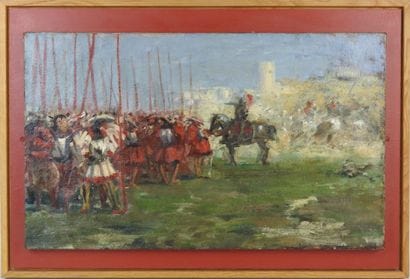
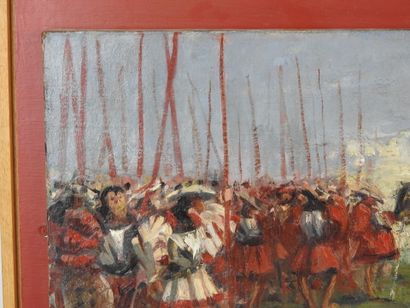
Francis TATTEGRAIN (Péronne, 1852 - Arras, 1915), attributed - Lot 33
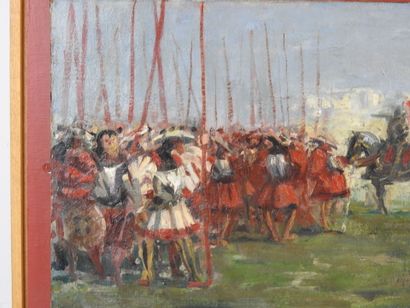
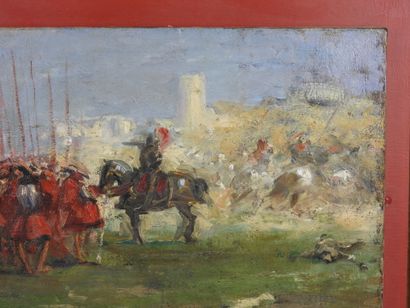
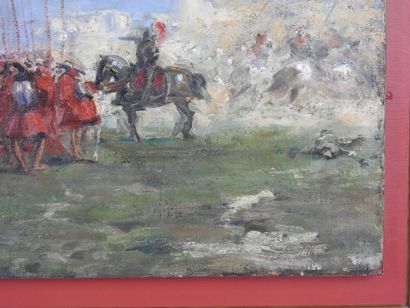
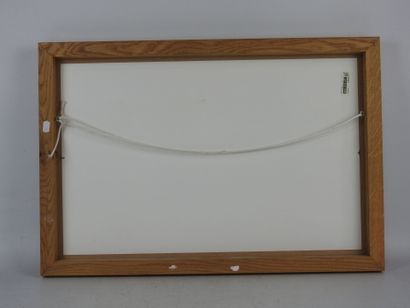
Francis TATTEGRAIN (Péronne, 1852 - Arras, 1915), attributed to. Battle scene at Marignan. Oil on canvas circa 1890. 33 x 55 cm. (On the reverse of the canvas, stamped: "Paul FOINET rue N.D Des Champs Paris" (a mark present from 1885 to 1897, according to Labreuche). American frame in natural wood 43 x 63 cm.
Provenance: private collection from Touraine, focusing on Beaux-Arts competitions and the Prix de Rome in the 19th and early 20th centuries, as well as academic works.
Francis Tattegrain was the third son of Charles-Louis Tattegrain (1806-1879)1, President of the Amiens Court, and Thérèse Marie Voillemier (1819-1881). Descended from a long line of magistrates and one of Péronne's oldest families, their great-great-grandfather was mayor of Péronne in 1781. Young Francis only received his father's approval to take up painting on the promise that he would study law. He went on to obtain a doctorate in law, after which he devoted himself exclusively to painting. Tattegrain discovered Berck with his parents as early as 1865. His father had a cottage built at 28, rue de l'Entonnoir in Berck. Young Francis' vacation spot was to become the main setting for his pictorial work. The arrival in Berck of Ludovic-Napoléon Lepic was a decisive factor: "what decided me to devote myself completely to painting was, in 1876, my meeting in Berck with Count Lepic, who was working on the beach in the breeze...". During the winter, he lived in Senlis, in the house of his maternal grandfather, Dr. Jean-Baptiste Voillemier (1787-1865), a close relative of the sculptor Edmé Bouchardon. This grandfather was also the first president of the town's Comité Archéologique since its foundation in 1863.
At the instigation of Ludovic-Napoléon Lepic and encouraged by his brother, the sculptor Georges Tattegrain, he pursued his artistic training in Paris at the same time as completing his doctorate in law. He entered the Académie Julian in 1877, where he studied under Jules Lefebvre and Gustave Boulanger. In 1879, two of his paintings were accepted at the Salon des artistes français, where he was exhibited continuously until 1914. On September 2, 1882, he married Eugénie Joséphine Anne Deleviéleuse Doudemont (†1941).
Honorable mention in 1881 for La Femme aux épaves, he was awarded a second-class medal in 1883 for Les Deuillants à Étaples, which took him out of the competition. The same year saw the birth of his first child, Robert, followed by Thérèse in 1886 and Jeanne in 1890. Francis Tattegrain was named Chevalier de la Légion d'Honneur in 1889, and was awarded the Medal of Honor for Saint Quentin pris d'assaut at the 1899 Salon. The medal was a mark of favor for one of the most honored painters of the Third Republic, who had been receiving numerous public commissions for almost twenty years. Édouard Herriot described him as having "the pencil of Ingres, the palette of Delacroix". His talent earned him numerous commissions, including L'Entrée de Louis XI à Paris for the Hôtel de ville de Paris in 1892, and later, La Cérémonie des récompenses. Universal Exhibition of 1900 in 1904.
A history painter, aquafortist for a brief period in the late 1870s and early 1880s, and portraitist, Tattegrain is above all a master of marine naturalism. His compositions are often boldly realistic, but always harmonious. His straightforward painting and accurate coloring underline the dramas usually staged in large-scale compositions. In 1882, he became a member of the Société des artistes français. In 1888, he presented the Alfred Danicourt Museum and his fellow Peronnians with an exceptional Debris of the Three-Masted Majestas. His virtuosity in handling dramatic, tragic and even sinister subjects, treated with a simplicity that does not exclude emotion, should not overshadow the profusion of subjects dealing with the daily life of Berck's fishermen. His territory of choice is the Bay of Authie, where he has acquired 100 hectares of dunes and built a studio enabling him to produce large-format work in natural light. He also worked all along the Opal coast, in Audresselles and as far as Wissant, where he frequently joined his friends the Demont-Breton family. His large painting of a shipwrecking couple at Cran aux œufs (near Audresselles), humorously entitled Sauveteurs d'épaves, dated 1912, long graced the Boulogne-sur-Mer auction room.
In 1894, he was invited by Léon Coutil, a history buff, to Les Andelys, and it was during this stay that he produced his painting Les Bouches inutiles, which he exhibited at the Salon des artistes français in 1896 and at the Exposition universelle in 1900. At least
My orders
Sale information
Sales conditions
Return to catalogue